
The River, the Deserts, and the Geography That Created a Civilization
Standing on the banks of the Nile, it is easy to forget that Egypt exists in one of the most unforgiving landscapes on Earth. Beyond the narrow ribbon of green that follows the river lies an immense expanse of desert stretching across thousands of kilometres. Yet precisely here, in this unlikely environment, one of the longest-lasting civilisations in human history emerged.
More than two thousand years ago, the Greek historian Herodotus, writing in the 5th century BC, captured this reality in a simple but powerful phrase:
“Egypt is the gift of the Nile.”
What he meant was not merely poetic admiration. Egypt did not emerge by chance. Its existence is the result of a remarkable geographical balance between river, desert, climate, and trade routes. The Nile made life possible, while the surrounding deserts shaped the boundaries and stability of the civilisation that grew along its banks.
Understanding why Egypt exists where it does means understanding the landscape itself.
The Nile’s northward course is one of the defining geographical features of Egypt, explained in detail in Why Does the Nile Flow North?
The Nile: A River That Created a Country
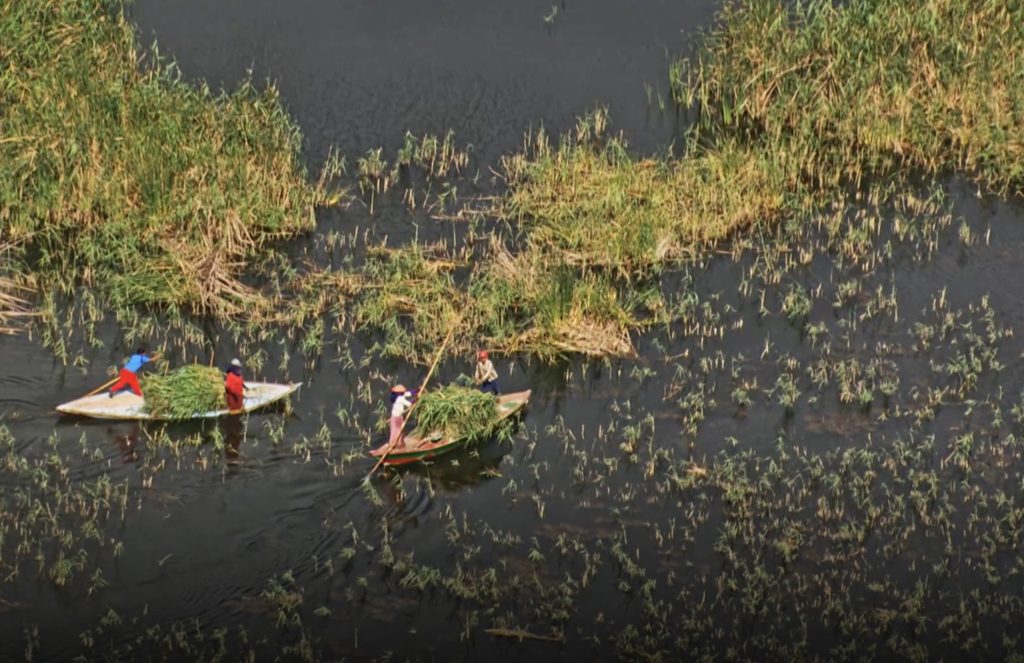
At the heart of Egypt lies the Nile River, one of the most remarkable waterways on Earth. The Nile is a major north-flowing river in northeastern Africa that empties into the Mediterranean Sea. At 7,088 kilometres in length, it is traditionally considered the longest river in the world.
Despite its great length, the volume of water it carries is far smaller than that of other major rivers such as the Amazon or the Congo, whose tropical basins receive much heavier rainfall.
What makes the Nile extraordinary is not its size alone but the role it played in shaping human civilisation. Each year the river flooded its banks, depositing nutrient-rich silt across the valley. This natural cycle transformed a narrow corridor of land into one of the most productive agricultural regions of the ancient world.
Crops such as wheat and barley flourished, sustaining populations and allowing cities to develop along the river.
Without the Nile, Egypt would simply be desert. With it, the land became the cradle of a civilisation that endured for more than three millennia.
A River Shaped by Deep Geological Time
Although the Nile seems eternal, geologically speaking it is a relatively young river. The river has flowed along roughly its present course for only about 12,000 years, after climatic changes at the end of the last Ice Age reshaped the drainage systems of northeastern Africa.
Earlier geological periods saw very different river systems across the region. Only when climatic conditions stabilised did the Nile valley form the continuous river corridor we recognise today.
In this sense, the landscape that allowed Egyptian civilisation to flourish is itself the result of relatively recent geological change.
The Name of the Nile
The name “Nile” carries its own long linguistic journey.
The English word “Nile” derives from the Latin Nilus, which itself comes from the Ancient Greek Νεῖλος (Neilos). The Greek term may ultimately originate from the Semitic word naḥal, meaning “river” or “valley stream.”
Ancient Egyptians themselves used different names for the river, often referring to it simply as Iteru, meaning “the river.”
For them the Nile was not merely a geographical feature. It was the defining element of their world.
A Green Corridor Through the Desert
Seen from above, Egypt appears as a striking contrast. A thin band of fertile green land follows the Nile through a vast sea of sand and stone.
This valley is rarely more than 10 to 20 kilometres wide, yet it supported millions of people throughout ancient history. Every settlement, temple, and agricultural field depended on the river’s presence.
The Nile therefore functioned not only as a source of water but also as Egypt’s main highway. Boats travelling along the river connected cities, temples, markets, and villages across hundreds of kilometres.
In this sense the Nile was more than a river. It was the spine of the country, the axis along which Egyptian civilisation developed.
A River and a Wind That Made Travel Possible
One of the most remarkable geographical features of the Nile is the natural system that made navigation possible for thousands of years.
The river flows from south to north, descending gradually from the highlands of East Africa toward the Mediterranean Sea. At the same time, the prevailing winds in Egypt blow in the opposite direction, from north to south.
This unique combination created a natural transportation system long before engines or modern infrastructure existed.
Boats travelling northward could simply follow the current of the river.
Boats travelling southward could raise their sails and use the steady northern winds to move against the current.
Thanks to this natural balance between river flow and wind direction, ancient Egyptians were able to navigate the Nile with remarkable efficiency. Traders, officials, pilgrims, and travellers could move along the river in both directions using simple sailing vessels.
This geographical advantage played a decisive role in the development of Egyptian civilisation. The Nile became not only a source of water and fertile soil but also the primary highway of the country.
Even today, traditional sailing boats such as feluccas and dahabiyas continue to rely on this same natural relationship between river current and prevailing winds.
The Deserts That Protected Egypt
Surrounding the Nile valley are vast desert regions that shaped Egypt’s historical stability.
To the west lies the Western Desert, part of the Sahara and one of the largest desert regions on Earth. Within it are dramatic landscapes such as the White Desert, the Black Desert, and the immense dune fields of the Great Sand Sea, punctuated by ancient oasis settlements including Siwa, Bahariya, Farafra, Dakhla, and Kharga.
To the east stretches the Eastern Desert, a rugged mountainous region between the Nile and the Red Sea. This landscape contains ancient mining areas and caravan routes linking the Nile with Red Sea ports used in antiquity for trade with Arabia, East Africa, and India.
Further north lies the Sinai Peninsula, a land bridge between Africa and Asia with its own unique desert mountains and plateaus.
Together these desert regions created natural barriers around the Nile valley. While not impossible to cross, they discouraged large-scale invasions and helped protect the civilisation that developed along the river.
A Natural Corridor Between Continents
Although the deserts protected Egypt, they also helped define its position as a crossroads between continents.
The Nile valley formed a natural corridor linking central Africa with the Mediterranean world. Through the Sinai Peninsula Egypt connected with the Near East and the Levant, while Red Sea ports linked the Nile to maritime routes reaching Arabia, East Africa, and India.
Merchants, diplomats, pilgrims, and travellers all moved through this landscape, following routes shaped by geography thousands of years earlier.
A Landscape That Shaped a Civilization
Ancient Egyptian society developed in close harmony with the rhythms of the Nile and the structure of the surrounding land.
Agriculture depended on the annual flood. Cities rose along the riverbanks. Temples were aligned with the movement of the sun and the flow of the river.
Even the way Egyptians described their own country reflected this geography.
River-Based Orientation
Ancient Egyptians did not orient themselves primarily by north and south but by the direction of the river.
• Upstream (south) was called Upper Egypt
• Downstream (north) was called Lower Egypt
The Nile defined orientation, agriculture, religion, and daily life. In many ways Egypt was not simply a country with a river. It was a civilisation built around one.
The Same Geography Still Defines Egypt Today
Thousands of years later the same geographical structure continues to shape Egypt.
Modern cities, agriculture, and transportation still follow the Nile valley. Travellers exploring the country today move along the same corridor that ancient Egyptians used thousands of years ago.
Travelling along the river today still reveals the same landscape that shaped Egyptian civilisation, as described in Nile Narratives: A Timeless Journey Through the Heart of Egypt.
Sailing between Aswan and Luxor, watching the river pass temples, villages, and desert cliffs, one experiences the same landscape that once sustained pharaohs, traders, and pilgrims.
The geography that created Egypt has never truly changed.
The Nile still flows north. The deserts still frame the valley. And the narrow green corridor along the river remains the heart of the country.