

Egypt and Maat
A river older than power
In Ancient Egypt, where the Nile has flowed for millennia without ever consulting the urgency of men, there existed a way of understanding the world that did not begin with human will, nor end with it.
Even today, the river continues its quiet course, rising and receding with a rhythm that does not answer to the noise of any age. It carries, in its own manner, the memory of a balance that once shaped an entire civilisation.
The ancient Egyptians called that balance, Maat.
Not a doctrine.
Not a decree.
Not a law written by men and amended by convenience.
Maat was something deeper. It was truth, balance, order, proportion, right measure. It was the invisible principle through which land, time, speech, power, justice, and human conduct were expected to remain aligned.
And within that order, even power had its place.
Not even the pharaoh stood outside the scale
It was said that the one who ruled, crowned in gold, exalted in stone, and spoken of as divine, did not stand above that order.
Not even the pharaoh.
He could command armies, raise temples, decree works that would outlive centuries, and be revered as a god on earth. But he could not displace balance itself.
Because balance did not belong to him.
It held him.
This is one of the most remarkable ideas of Ancient Egypt. Power was not conceived as an escape from measure. It was not a privilege that placed one beyond judgment. On the contrary, the more elevated the ruler, the greater the obligation to preserve order.
The pharaoh was not divine in order to be exempt.
He was sacred because he was entrusted with maintaining Maat.
Power as burden, not immunity
To rule in that world was not simply to govern. It was to carry a responsibility far greater than personal will.
The ruler was expected to protect balance between abundance and scarcity, between force and justice, between the river and the people who depended on it, between the visible order of the kingdom and the invisible order that sustained it.
Power was not protection.
It was exposure.
The higher the authority, the greater the consequences of disorder. The weight of bad rule did not fall only upon the ruler. It reached the people, the harvest, the courts, the peace of the land, and the continuity of the state itself.
That is why corruption in Ancient Egypt was not merely an offence in the administrative sense. It was a disturbance of order. A breach in the equilibrium on which survival depended.
The light heart and the heavy heart
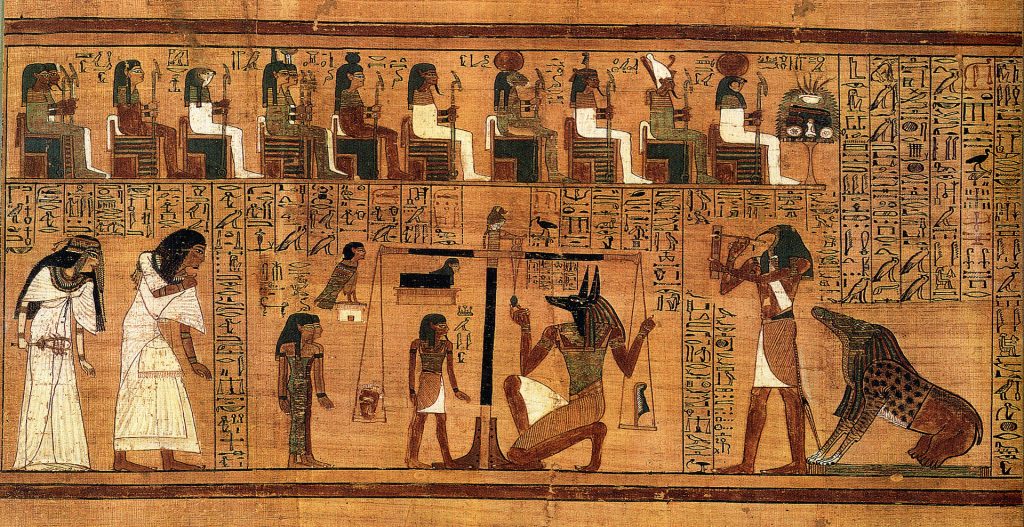
The Egyptians told it as a story, but it was more than a story. It was the moral architecture of a civilisation.
One day, beyond the visible world, each life would arrive in the hall of judgment.
There, no title could intervene. No rhetoric could assist. No wealth, rank, or ceremony could distort what was to come.
A heart.
And a feather.
The heart of the one who had lived.
And the feather of Maat.
Placed on a scale.
No argument.
No defence.
Only weight.
A light heart was not a heart without action. It was not naivety, weakness, or innocence in the childish sense. It was a heart that had remained within measure. A heart that had not taken more than was just, had not bent truth for private convenience, had not profited from imbalance, had not fed itself on what belonged to others.
A heavy heart was something else.
It carried excess.
It carried distortion.
It carried all that had been acquired without right measure, all that had been imposed without justice, all that had been decided in favour of oneself at the cost of balance.
Nothing needed to be proven, because nothing had disappeared.
The scale did not forget.
No distinction before the feather
And it did not matter who that heart had belonged to.
Not the farmer.
Not the scribe.
Not the official.
Not the ruler.
This is where Ancient Egypt remains more intellectually unsettling than many later systems of power.
Because power was never an exemption.
It was a responsibility under greater order.
A different idea of sacred kingship
This was not kingship in the sense later imagined elsewhere.
It was not the model of rulers declared inviolable by divine sanction. Not the logic that appeared in Rome, where emperors could be elevated beyond ordinary human limits. Not the later kingdoms of Christianity, where kings and queens were crowned by bishops, anointed as specially touched by God, set apart from others, and in many cases surrounded by a sacred aura that made them seem answerable only to heaven.
In those systems, proximity to the divine could become a shield.
It could protect the ruler from question. It could turn sacred language into political insulation. It could suggest that power descended from above and therefore could not be weighed by those below.
Ancient Egypt proposed something far more demanding.
The closer one stood to the divine principle, the less one could deviate from it.
The pharaoh was not sacred because he could do as he wished.
He was sacred because he was bound to maintain the order on which all others depended.
There was no immunity in that.
There was only obligation.
The Nile and the discipline of balance
Along the Nile, life unfolded in accordance with this understanding.
The river did not teach excess. It taught rhythm.
Its flood could nourish or destroy. Its withdrawal could reveal fertile land or expose fragility. Everything depended on proportion, on timing, on respect for measure. Fields were marked, temples aligned, rituals ordered, speech weighed.
Balance was not an abstract virtue.
It was continuity.
To disturb it was not simply wrong. It was dangerous.
A civilisation learned to endure not because it accumulated limitless power, but because it understood that survival required order more than spectacle.
And perhaps that is why the Nile still speaks so strongly to those who travel beside it today. Not because it explains itself, but because it continues. Quietly. Exactly. Without needing to insist.
What was forgotten and what remains
Time passed. Empires rose elsewhere. Other languages of power prevailed. Louder languages. Faster ones. Languages more eager to celebrate conquest, possession, and display than proportion, truth, and restraint.
Maat faded from public memory.
But disappearance is not the same as absence.
The name may have been forgotten, yet the measure remains.
The feather remains.
Light. Exact. Unmoved.
Waiting for every heart.
Not only those of the past, but those of the present. Those who govern, influence, decide, accumulate, command, and persuade. Those who build modern empires of finance, image, politics, force, or narrative. Those who imagine themselves untouchable because their power is vast, immediate, or applauded.
Ancient Egypt would have recognised none of that as exemption.
The scale was never dismantled.
Only ignored.
What the temples still remember
This is why travelling through Egypt is never only aesthetic.
Temples, tombs, inscriptions, processional spaces, and river landscapes do not merely preserve beauty. They preserve an idea.
They remind us that there once existed a civilisation in which order was sacred, in which power was measured, in which even the highest stood under a principle they did not create and could not escape.
That is not a minor historical curiosity.
It is one of the greatest political and spiritual ideas ever shaped on earth.
And the Nile, still moving in its ancient rhythm, continues to carry it.
Only weight
Perhaps that is why Ancient Egypt still unsettles modern minds.
Because it leaves behind a question that has never ceased to matter.
What becomes of power when it is no longer measured by balance
What becomes of rule when it forgets duty
What becomes of a heart when it grows heavy with all it believed it could keep
Ancient Egypt gave its answer long ago.
One day there will be no title, no ceremony, no applause, no army, no office, no fortune, no bishop, no court of flatterers, no shield of prestige, no escape into language.
There will be no argument. Only weight.