What Visitors Need to Know About Safety, Energy and the Reality Beyond European Headlines
A Clear Perspective for Travellers Arriving from Europe
There is a persistent distance between how Egypt is described from Europe and how it is actually experienced on the ground.
From afar, narratives tend to compress complexity into a single frame. Questions of safety, energy supply, and geopolitical tension are often presented as if they applied uniformly across the country. Yet Egypt is not a single, undifferentiated space. It is a vast territory, and its realities change significantly depending on where one travels.
For those who move through Upper Egypt — along the Nile, in Aswan, in smaller villages and desert environments — this difference becomes immediately visible. Life follows a rhythm that is stable, structured, and deeply rooted in continuity. The gap between perception and reality is not subtle; it is tangible.
Safety in Egypt Is a Question of Geography
The question of safety in Egypt cannot be approached in abstract terms. It must be located.
Tourism in Egypt is organised around clearly defined regions where infrastructure, experience, and long-standing interaction with international visitors are well established. Upper Egypt — particularly the stretch between Aswan and Luxor — has for decades been one of the most stable and controlled travel corridors in the country.
This is not incidental. It is where some of the most important historical sites in the world are located, and where travel has developed within a structured and predictable framework.
Understanding this changes the nature of the question itself. It is no longer simply whether Egypt is safe, but where and how one travels within it.
Energy, Perception and the European Narrative
Recent news has focused on energy-saving measures in Egypt, sometimes described in terms that suggest broad disruption.
The reality is more nuanced.
In large urban centres such as Cairo, adjustments to commercial schedules may occur as part of wider energy management strategies. This is not unique to Egypt and reflects pressures that are equally present across Europe.
Beyond the major cities, however, a different structure becomes visible. In many areas along the Nile, and particularly in villages and desert environments, a significant degree of energy independence already exists. Solar panels are widely used, not as a recent innovation, but as a practical system developed over time.
For travellers, this distinction is essential. The experience of Egypt — especially outside Cairo — is far less affected by these dynamics than external narratives tend to suggest.
A Strong Position for European Travellers
While concerns are often emphasised, another factor receives less attention.
The euro remains strong in relation to the Egyptian pound. This creates a context in which high-quality, private and carefully structured travel experiences are more accessible than many expect.
What might be considered a premium level of travel in Europe becomes, in Egypt, both attainable and proportionate in value. This has a direct impact on how one travels — the time available, the level of comfort, and the ability to avoid rushed or crowded itineraries.
Where Egypt Is Best Understood
Egypt is not experienced in abstraction. It is experienced through landscape and movement.
Along the Nile, particularly between Aswan and Luxor, the country reveals a continuity that is difficult to perceive from outside. The river structures everything — agriculture, settlement, daily life, and the relationship between past and present.
This is not a landscape designed for rapid consumption. It unfolds gradually. The sense of place emerges through time rather than through isolated visits.
How to Travel Egypt Safely and Coherently
Safety is closely linked to the form of travel chosen.
Compressed itineraries, designed to cover large distances quickly, often reduce clarity of experience. In contrast, slower forms of travel — particularly along the Nile — allow for a more controlled and coherent understanding of the environment.
Private or small-scale journeys, guided by local knowledge, create a different dynamic. They allow travellers to move through the country with continuity, rather than fragmentation.
Experiencing the Nile Today
For those who choose to follow the Nile, travel becomes more than a sequence of locations.
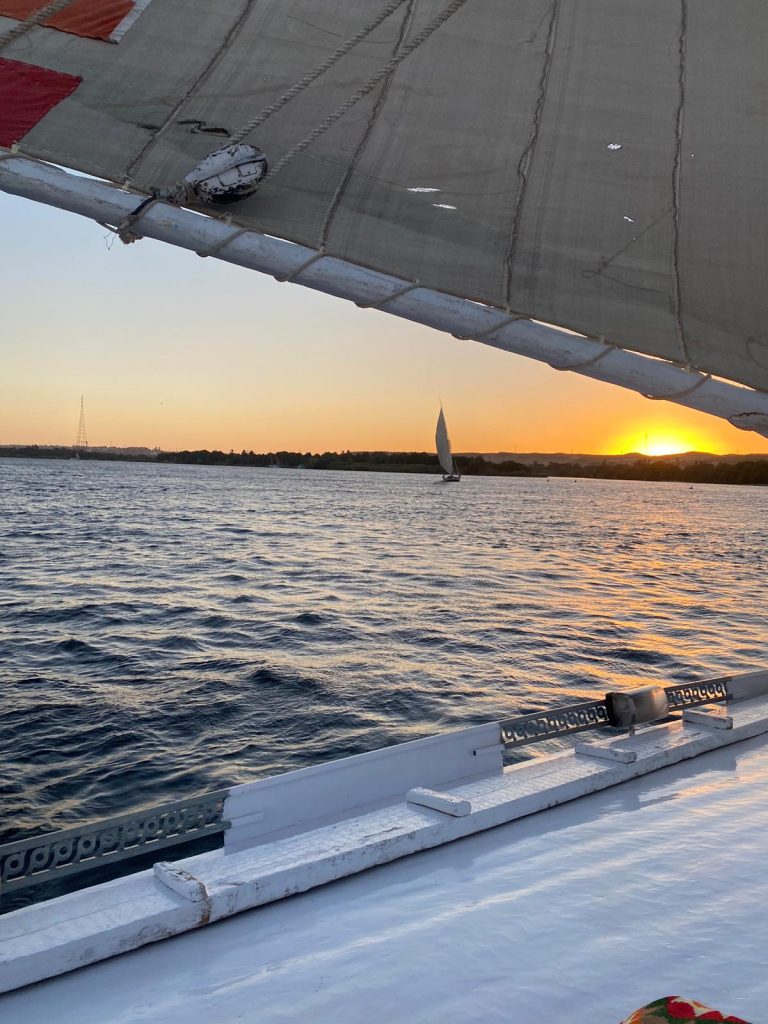
Sailing from Aswan toward Luxor follows the natural course of the river. Landscapes open progressively. Villages appear without interruption. The relationship between water, cultivation, and desert becomes visible in its full context.
This experience can take different forms.
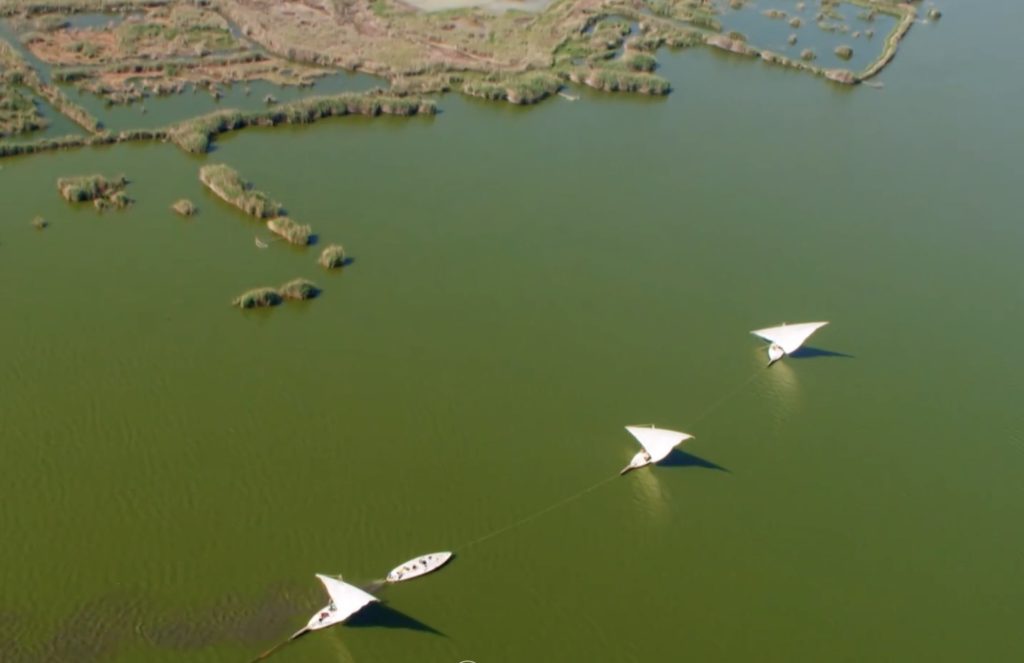
– On a traditional felucca, moving with the wind, reaching quiet riverbanks and islands
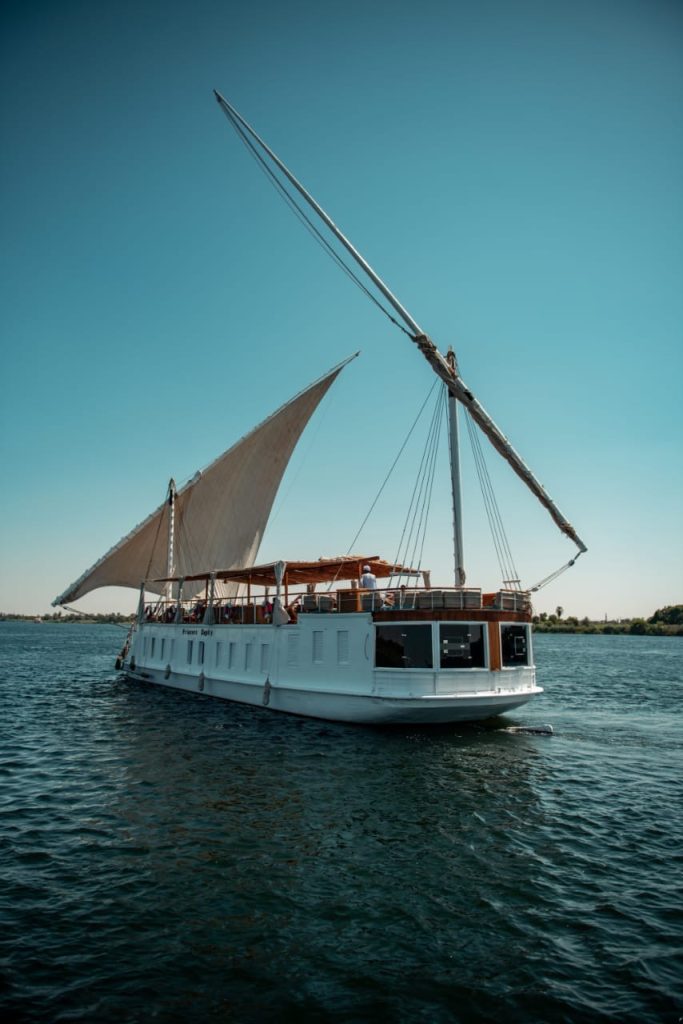
– On a dahabiya, offering space, comfort, and a slower, more structured journey
Both approaches share a common principle. They follow the river, rather than imposing upon it.
Discover private Nile journeys here
A Question of Perspective
Egypt in 2026 is not defined by headlines.
It is defined by geography, by continuity, and by the structures that have shaped life along the Nile over centuries.
For travellers willing to move beyond simplified narratives, the country offers something increasingly rare — time, space, and a form of travel that is not driven by urgency.
The question is not only whether Egypt is safe.