

Egypt After 30 BC: From Kingdom of the Pharaohs to Roman Imperial Province
In 30 BC, after the defeat of Mark Antony and Cleopatra VII following the Battle of Actium (31 BC), Egypt was annexed by Emperor Augustus and transformed into a Roman imperial province. From that moment Egypt became one of the most strategically important territories of the Roman Empire. Its significance was not only cultural but deeply economic. Egypt rapidly became the breadbasket of Rome, supplying enormous quantities of grain that fed the population of the imperial capital. At the time Rome was the largest city in the known world, with perhaps one million inhabitants, and its food supply depended heavily on the fertile harvests of the Nile valley. Yet Egypt was already famous long before the Romans arrived. When Roman travellers came to the Nile they encountered monuments that were already more than two and a half millennia old. For them, Egypt was not merely another province; it was a land of ancient wonders.
Monuments Already Ancient to the Romans
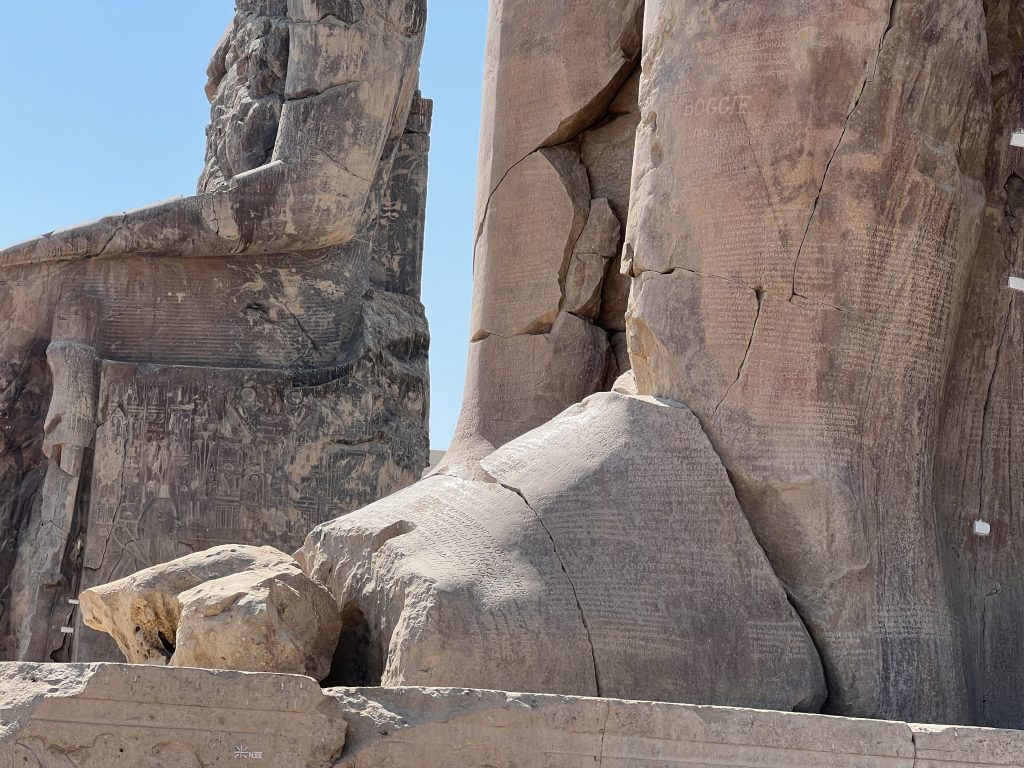
By the first century AD the Great Pyramids of Giza, constructed around 2600–2500 BC during the Fourth Dynasty, were already among the oldest monumental structures still standing anywhere on Earth. Roman travellers visited them with the same sense of awe experienced by modern visitors. Evidence of these ancient travellers survives in the form of Greek and Latin graffiti carved into temple walls and monuments. One of the most fascinating examples comes from the Colossi of Memnon near Thebes (modern Luxor). After an earthquake in 27 BC, one of the giant statues began to produce a mysterious sound at sunrise due to cracks in the stone. Romans believed the statue was singing. Visitors from across the empire travelled to hear the phenomenon and carved inscriptions on the monument recording their presence. One Roman traveller wrote a short message that has survived nearly two thousand years: “I, Gaius Julius Balbillus, heard the voice of Memnon.” These inscriptions are among the earliest surviving examples of something that feels very much like tourist graffiti.
Roman travellers were so impressed by the site that many carved their names into the statue itself. More than one hundred inscriptions left by visitors between the 1st and 3rd centuries AD still survive today.
Alexandria: Intellectual Capital of the Roman Mediterranean
One of the most important destinations for Roman visitors was Alexandria, founded in 331 BC by Alexander the Great. By the Roman period the city had become one of the largest and most cosmopolitan cities in the Mediterranean world. It was second only to Rome in population and importance. Alexandria’s reputation rested largely on its intellectual life. The city was home to the famous Library of Alexandria and the scholarly institution known as the Mouseion, where scholars studied mathematics, astronomy, medicine, philosophy, and geography. Intellectuals from across the Roman world travelled to Alexandria to study, debate, and exchange ideas. Another marvel of the city was the Lighthouse of Pharos, built in the 3rd century BC and rising perhaps 100–120 metres high. It was one of the Seven Wonders of the Ancient World and guided ships safely into Alexandria’s enormous harbour. For travellers arriving by sea, the lighthouse symbolised both the technological brilliance and the prestige of the city.
Egypt as the Breadbasket of the Roman Empire
Beyond its monuments and learning, Egypt held enormous economic importance for Rome. The annual flooding of the Nile deposited fertile silt along the riverbanks, allowing agriculture to flourish in a region otherwise surrounded by desert. Roman administrators carefully organised grain production and shipment. Every year fleets of cargo ships transported grain from Alexandria to Rome, ensuring the stability of the empire’s food supply. Ancient writers such as Juvenalnoted how dependent Rome had become on Egyptian harvests. Without the grain of the Nile valley, feeding the population of the imperial capital would have been impossible. This economic role made Egypt not only a cultural destination but also a vital strategic territory within the Roman world.
Religious Pilgrimage and Sacred Travel
Egypt also attracted visitors for religious reasons. The worship of Isis, originally an Egyptian goddess, spread widely across the Roman Empire. Temples dedicated to Isis appeared from Italy to Britain, and pilgrims travelled to Egypt to visit the sacred centres associated with her cult. One of the most important pilgrimage destinations was the Temple of Philae near Aswan, which remained an active religious sanctuary well into the Roman period. Another major religious site was the Serapeum of Alexandria, dedicated to the god Serapis, a deity combining Egyptian and Greek religious traditions. Pilgrims sought healing, divine guidance, and spiritual experiences at these temples, contributing to the constant flow of travellers entering Egypt.
Travelling the Nile in Antiquity
The Nile itself served as the great travel route through Roman Egypt. Visitors arriving in Alexandria could sail south along the river, stopping at cities and temple complexes that lined its banks. Boats carried merchants, administrators, scholars, and pilgrims through a landscape that was both fertile and monumental. Along the Nile stood some of the most impressive temple complexes of antiquity, including Dendera, Edfu, Kom Ombo, and Philae. For Roman travellers, sailing the Nile offered a journey through a landscape where ancient temples rose above green fields bordered by desert cliffs.
A Travel Tradition More Than Two Thousand Years Old
Although the word “tourism” did not exist in the Roman world, the motivations behind travel to Egypt were remarkably similar to those of modern travellers. Visitors came to admire ancient monuments, participate in religious ceremonies, pursue learning in Alexandria, conduct trade, and experience one of the most extraordinary landscapes of the ancient world. More than two thousand years later, the same temples, monuments, and river landscapes continue to attract visitors from across the globe. The fascination that once drew Roman travellers to the Nile remains very much alive today. In this sense, Egypt’s tradition of welcoming travellers is not modern at all. It is one of the oldest travel traditions in human history.