

Egypt’s Attempt to Conquer the Desert
Before the Desert
Ten thousand years ago the landscapes surrounding today’s Lake Nasser and the Western Desert looked profoundly different from what we see now.
Large parts of the Sahara were not desert at all. They were savannahs, lakes and seasonal rivers. Rock art discovered across southern Egypt, Sudan and Libya shows animals that feel almost impossible in the modern Sahara: elephants, giraffes, lions and large herds of cattle. Crocodiles lived in lakes scattered across the region.
Scientists refer to this era as the African Humid Period, when stronger monsoon systems brought far more rainfall into North Africa. What we now call the Sahara was then a vast ecological corridor where animals and humans could live far from the Nile.
Over thousands of years the climate slowly changed. Subtle shifts in Earth’s orbital cycles altered rainfall patterns. The monsoons weakened, lakes dried, vegetation disappeared, and the Sahara gradually transformed into the immense desert we know today.
Human populations migrated toward the one reliable artery of water that remained.
The Nile.
It was along this narrow ribbon of fertility that Egyptian civilisation emerged and endured for more than three millennia, surrounded by expanding seas of sand.
As explored in The Nile: The River That Created Egypt, the river shaped not only agriculture but the entire geography of Egyptian civilisation.
The Memory Still Exists in the Desert
The ancient green Sahara is not only a theory of climate science. Its traces still exist on the ground.
In the remote expanses of Egypt’s Western Desert, particularly in Al-Wadi Al-Gadid near the Libyan border, archaeological remains reveal that people once lived far from the Nile. Stone tools, fragments of early settlements and other traces can still be found by those patient enough to explore the landscape.
I have seen this myself while travelling through that region. Standing in those silent deserts, where the wind moves across endless sand and rock, it becomes easier to imagine that this landscape once supported life very differently from today.
The Sahara carries a long memory beneath its surface.
New Water, New Civilisations
When the climate became drier, Egypt’s entire civilisation concentrated along the Nile valley. The river’s annual flood provided the water and fertile soil that sustained agriculture and population.
Centuries later, in the 7th century, the Arab world brought new irrigation techniques to Egypt. Water wheels, canals and improved hydraulic systems expanded agricultural production and allowed cultivation to spread beyond the natural floodplain in some regions.
Yet even then the desert itself remained largely unconquered.
The Nile valley continued to define the limits of life in Egypt.
The Twenty-First Century Experiment
Today Egypt is attempting something far more ambitious.
Modern engineering, drilling technology and large irrigation systems are pushing agriculture into landscapes that for thousands of years remained entirely barren.
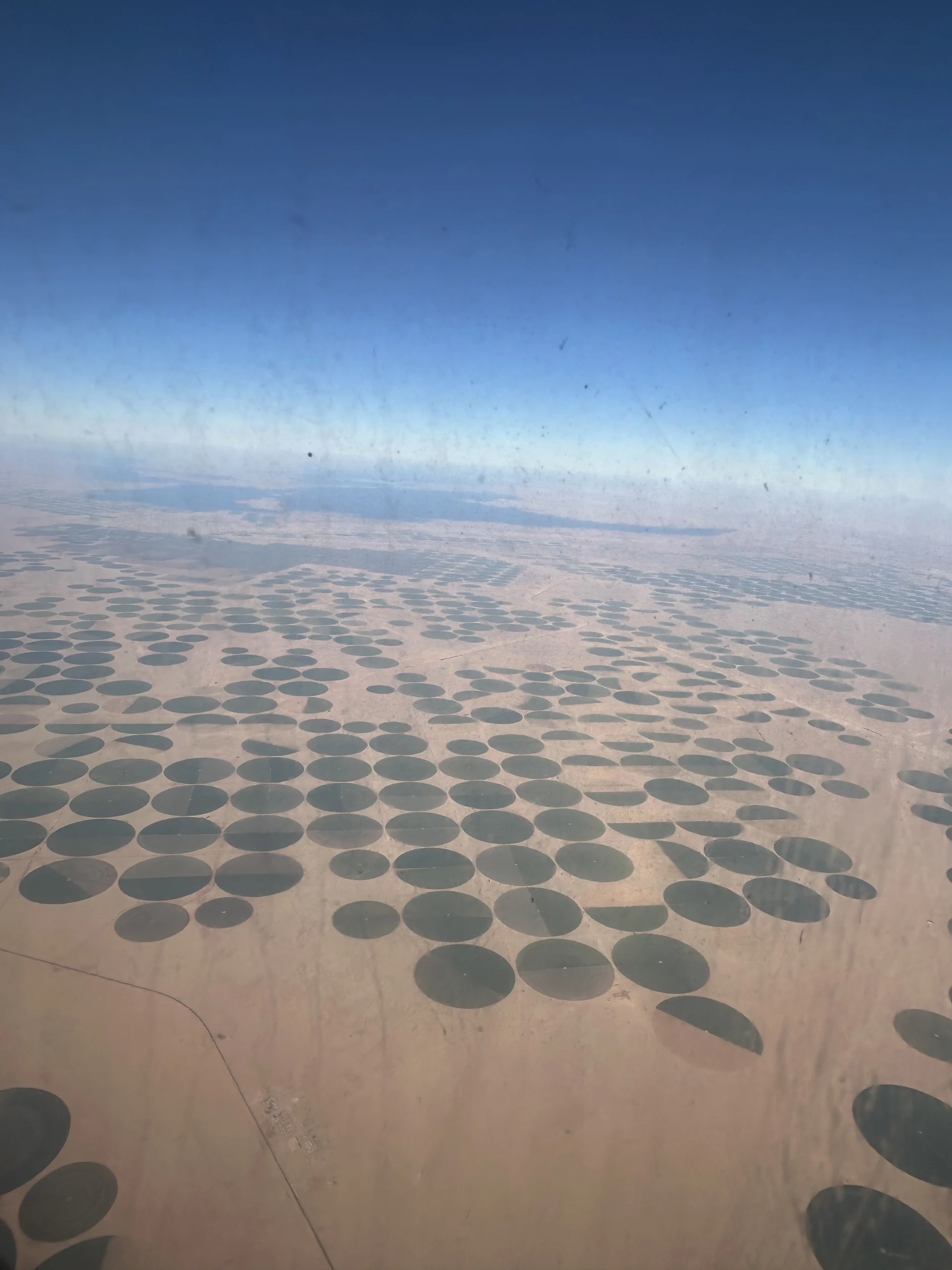
Flying south over Egypt toward Abu Simbel, the desert stretches endlessly beneath the aircraft.
Travellers visiting this region during Nile journeys through Upper Egypt, often discover how dramatically the landscape shifts from fertile riverbanks to vast desert.
The green ribbon of the Nile has long disappeared. Only sand, rock and silence fill the horizon.
And then, suddenly, something unexpected appears.
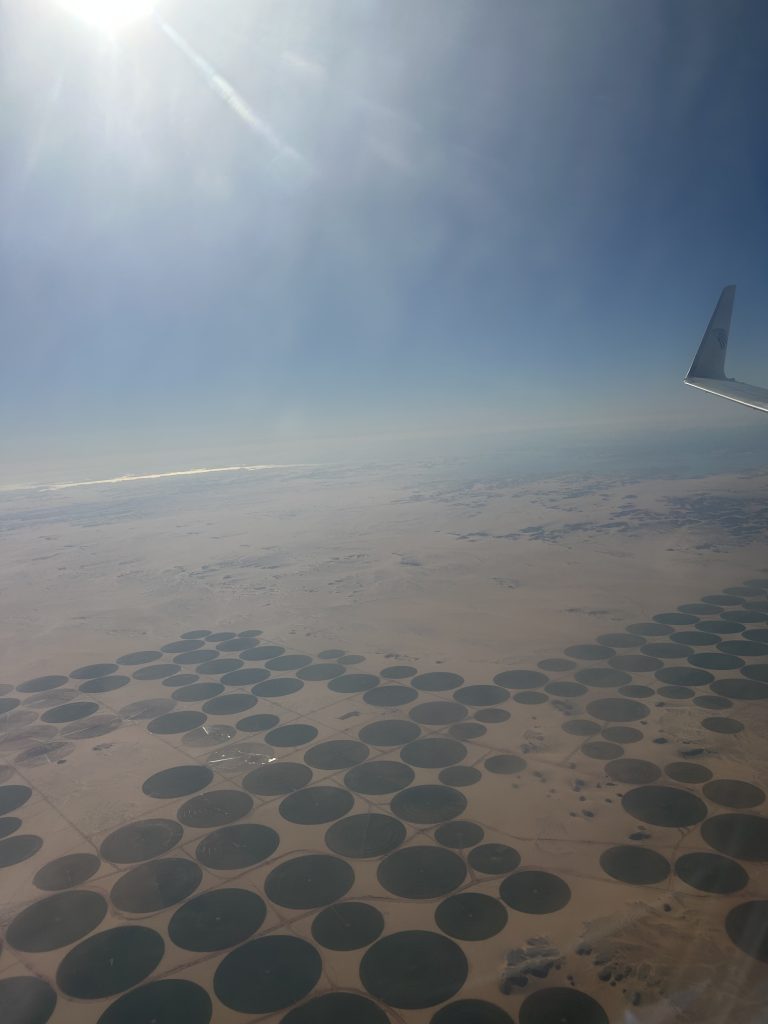
Perfect green circles scattered across the desert.
These circles are created by center-pivot irrigation systems, large rotating arms that distribute water around a central well. As the irrigation arm slowly turns, it waters crops in a perfect circle, producing the unmistakable geometric patterns visible from the air and even from satellites.
Each circle may cover dozens of hectares of farmland.
From the window of an airplane they look like coins placed carefully on the surface of the Sahara.
The Engineering Behind the Circles
Some of these farms rely on deep groundwater reserves such as the Nubian Sandstone Aquifer, one of the largest underground freshwater systems on Earth. Much of this water accumulated thousands of years ago when the Sahara was still a wetter landscape.
But Egypt is also experimenting with something even more ambitious.
In several regions, the government is pumping Nile water into the desert itself, extending canals and pipelines far beyond the traditional agricultural zones. Projects connected to the Toshka development south of Lake Nasser and other desert reclamation initiatives aim to transform large areas of previously barren land.
This effort does not stop near Abu Simbel.
The same vision extends further west toward the desert oases and regions such as Dakhla, where water infrastructure is being expanded to support new agricultural settlements.
I have also seen some of these early stages myself. In certain places the engineering work is still in its infancy. Canals, pumping stations and new irrigation systems are only beginning to reshape the landscape.
For now the desert still dominates.
But the intention is clear.
Egypt is attempting to move agriculture beyond the ancient limits imposed by the Nile valley.
Islands of Green in an Ocean of Sand
Seen from above, the green circles scattered across the Sahara are more than just farms.
They are small experiments in rewriting the geography of life in Egypt.
For thousands of years Egyptian civilisation depended almost entirely on the Nile. Today engineers, farmers and planners are cautiously pushing that boundary outward.
Some projects will succeed.
Others may struggle with the immense challenges of water, energy and climate.
The Sahara has always tested those who attempt to tame it.
Yet the circles visible from the air tell a remarkable story.
After thousands of years living within the narrow ribbon of the Nile, Egypt is once again trying something extraordinary.
To push life back into the desert.