

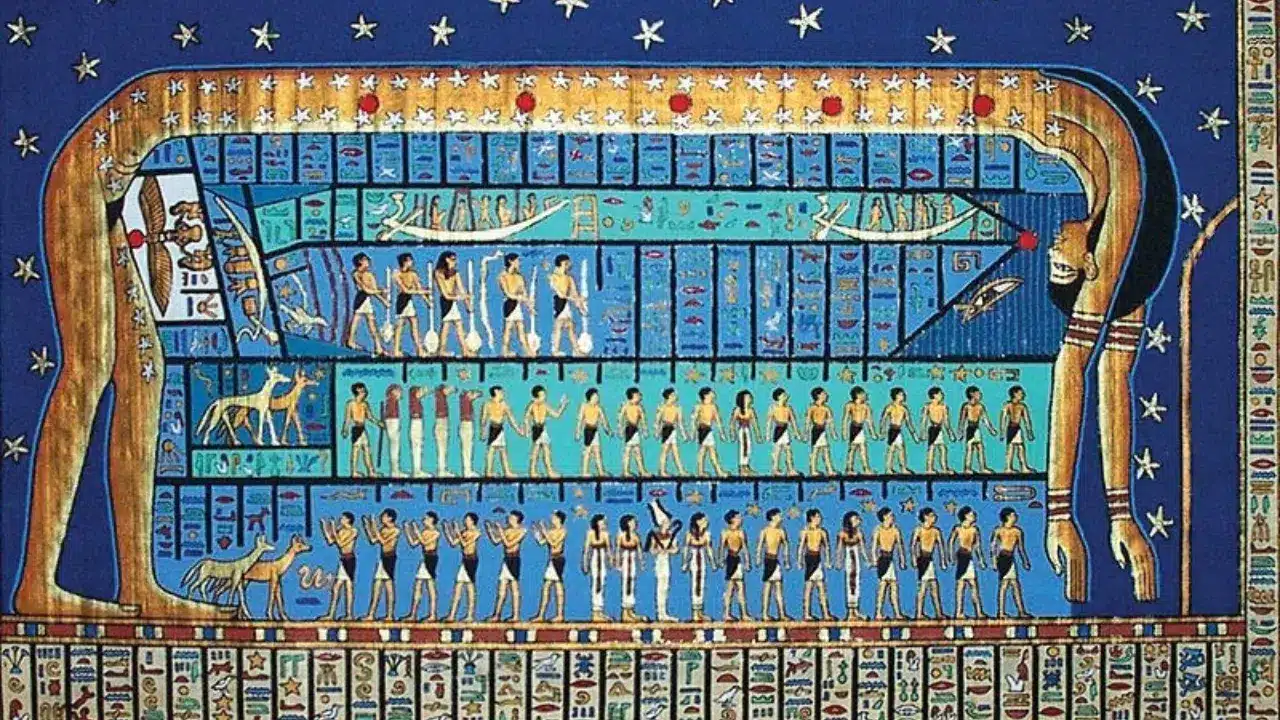
The stars of Egypt, from Sirius and Orion to the celestial ceilings of temples and pyramids

Ancient Egyptian astronomy is one of the earliest and most sophisticated systems of observing the night sky in human history. Thousands of years before telescopes, Egyptian priests and astronomers carefully studied the movement of stars, planets, and constellations to measure time, guide religious rituals, and understand the cosmos.
For the ancient Egyptians, the sky was not simply a backdrop above the desert. It was a cosmic map that guided agriculture, religion, architecture, and the journey of the soul after death.
Today, archaeological discoveries across Egypt—from desert stone circles to temple ceilings—reveal how deeply Egyptian civilization was connected to the stars.
Why Astronomy Was Essential in Ancient Egypt
Ancient Egyptian society depended heavily on the natural cycles of the Nile and the rhythms of the sky. Observing the stars allowed priests and scholars to develop calendars, predict seasonal changes, and organize religious festivals.
One of the most important stars was Sirius, known in ancient Egypt as Sopdet. Each year, the heliacal rising of Sirius—its first appearance just before sunrise—announced the annual flooding of the Nile.
This event marked the beginning of the Egyptian year and the renewal of agricultural life across the Nile Valley.
The Egyptians also divided the night sky into decans, groups of stars used as a type of celestial clock. By observing the rising of these stars during the night, priests could measure time with remarkable accuracy.
The Star Knowledge of Egyptian Priests
Astronomy in Egypt was closely connected to religion and temple life. Priests were responsible for observing the sky and maintaining astronomical knowledge.
Their observations influenced temple construction, sacred calendars, agricultural cycles, and royal symbolism.
The pharaoh himself was believed to join the imperishable stars after death, becoming part of the eternal cosmos. This belief explains why many royal tombs and pyramids were aligned with particular celestial directions.
Archaeological Sites That Reveal Egyptian Astronomy
Across Egypt, several important archaeological discoveries demonstrate the deep astronomical knowledge of ancient Egyptian civilization.
Nabta Playa: One of the World’s Oldest Astronomical Sites
Located deep in the Nubian Desert, Nabta Playa is one of the earliest known astronomical sites on Earth, dating back nearly 7,000 years.
Stone circles discovered there appear to align with the summer solstice and other celestial events. These structures suggest that prehistoric communities in the region were already observing the sky long before the pyramids of Egypt were built.
The Dendera Zodiac
Inside the Temple of Hathor at Dendera, visitors can see the famous Dendera Zodiac, a circular celestial map carved into stone.
The relief shows constellations, zodiac symbols, and planetary movements, illustrating how Egyptian priests visualized the structure of the universe and the movement of heavenly bodies.
The Pyramids of Giza and Orion’s Belt
The Pyramids of Giza are among the most precisely aligned structures of the ancient world.
Some researchers have suggested a symbolic relationship between the layout of the pyramids and the stars of Orion’s Belt, associated in Egyptian mythology with the god Osiris and the pharaoh’s journey to the afterlife.
The Astronomical Ceiling of Senenmut
The tomb of Senenmut, the architect of Queen Hatshepsut, contains one of the earliest known astronomical ceilings.
This painted ceiling depicts constellations, decans, and planetary movements that were used as star clocks to measure time during the night.
The Cairo Calendar
The Cairo Calendar, a papyrus dating to around 1200 BCE, records lucky and unlucky days based on celestial observations.
This document shows how astronomy influenced daily life and religious practices in ancient Egyptian society.
Stars, Gods, and the Egyptian Cosmos
Egyptian astronomy blended careful observation with mythology.
The sky was imagined as the goddess Nut, arching over the earth and swallowing the sun each evening before giving birth to it again at dawn.
The pharaoh’s soul was believed to ascend into the heavens and join the imperishable stars, which never disappeared below the horizon.
In this worldview, astronomy was both science and spirituality.
Experience the Ancient Egyptian Sky with EgyptDiscovering
Imagine standing beneath the quiet desert sky, far from modern city lights, watching the same constellations that ancient Egyptian priests studied thousands of years ago.
With EgyptDiscovering, travelers can explore temples, pyramids, and ancient landscapes while learning about the extraordinary relationship between Egyptian civilization and the cosmos.
Along the Nile and across the desert, the stars still shine exactly as they did in the time of the pharaohs.
Join an EgyptDiscovering Journey
Discover the temples, deserts, and ancient skies that shaped one of the most remarkable civilizations in history.
To reserve your Nile journey or learn more about our tours:
book@egyptdiscovering.com
The Nile flows as it always has, and above it the same ancient stars continue to shine.