

Sailing the Nile by Felucca: The Most Authentic Way to Experience Egypt
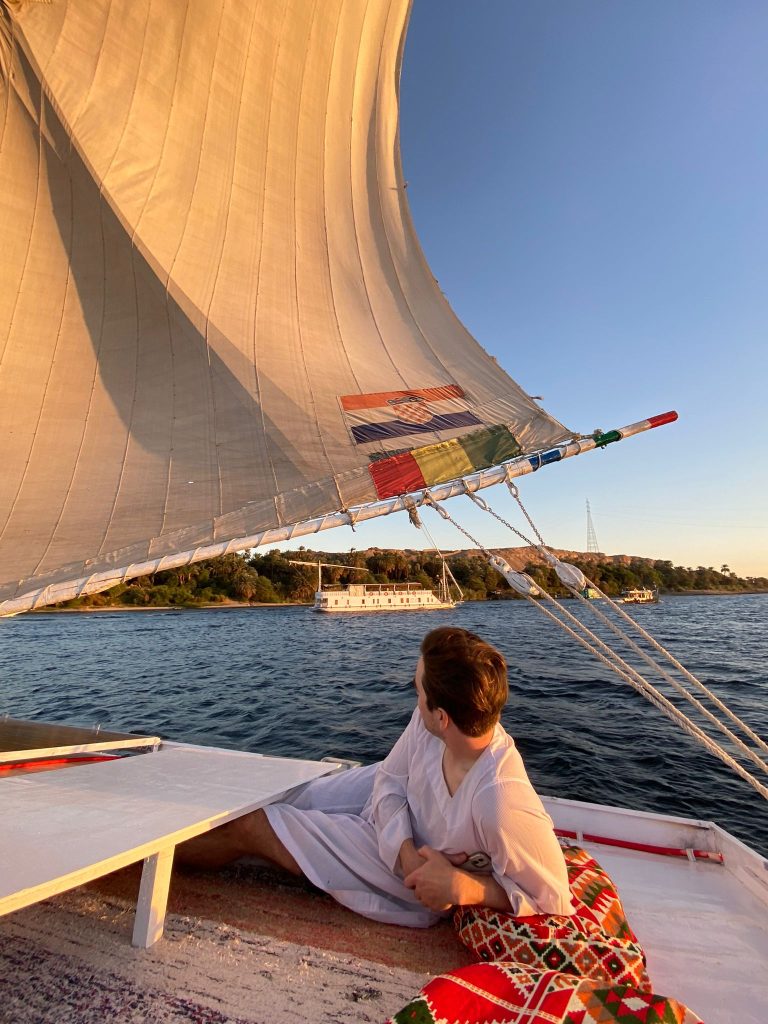
There is a particular silence on the Nile that does not belong to absence, but to continuity. It is the kind of silence that has carried voices, trade, prayers, and memory for millennia, and still moves with the same patient authority. To sail the Nile on a traditional felucca is to enter that continuity without interruption.
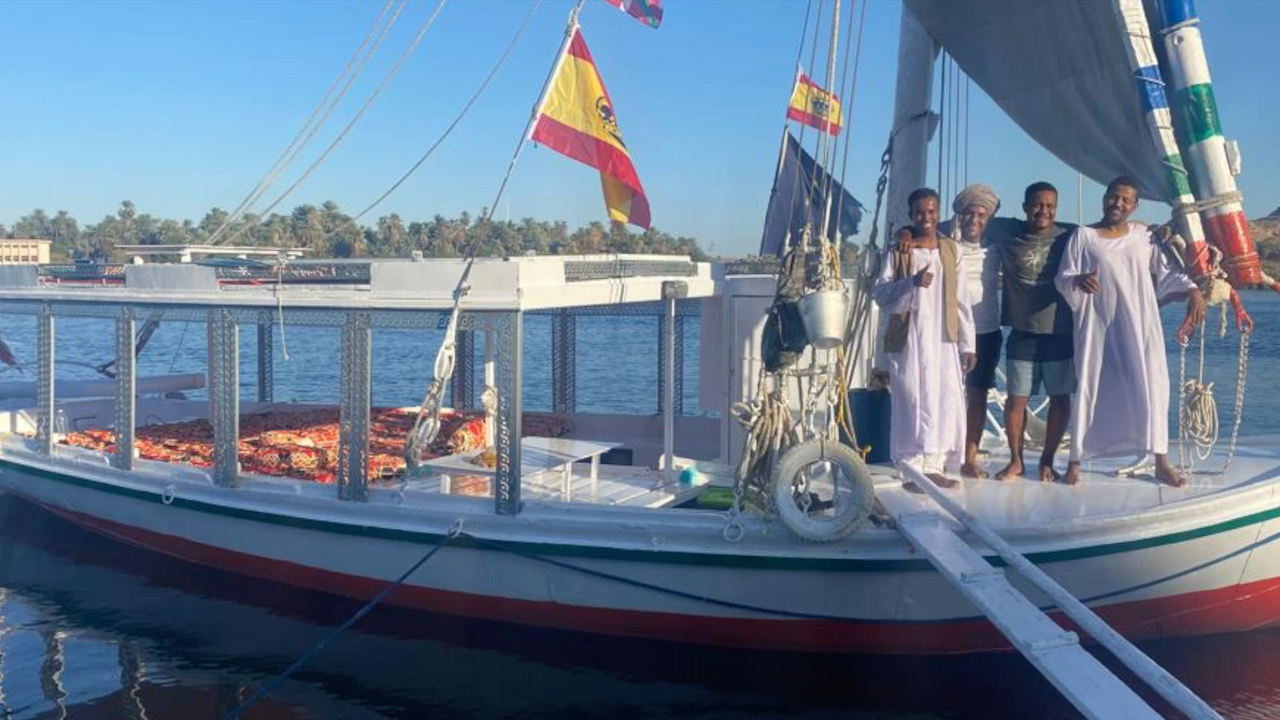
The felucca itself is an answer that predates the question. A simple wooden boat, shaped by necessity and refined by experience, it depends on nothing but wind, current, and the judgment of the man who steers it. There is no machinery to impose rhythm, no engine to fracture the sound of water. Movement is negotiated, not forced. The sail fills, relaxes, adjusts. The river accepts or resists. And slowly, almost imperceptibly, one begins to understand that this is not transport. It is alignment.
What was once the working boat of fishermen has not been replaced, only reinterpreted. The same structure that carried nets now carries travelers seeking an authentic Nile experience, yet it has not surrendered its nature. This is precisely what gives the journey its weight. It has not been redesigned for the visitor. The visitor has to adapt to it. And in that reversal, something rare happens. The journey ceases to be consumption and becomes attention.
The banks of the Nile do not present themselves as spectacle. They unfold. A field appears, then a small house, then a figure moving with the unselfconscious certainty of routine. Nothing is arranged, nothing explained, yet everything speaks. The river does not offer narratives. It reveals them to those who remain long enough to notice.
For those who travel with children, the effect is immediate and unfiltered. Deprived of distraction, the child enters the landscape without mediation. Water becomes movement, wind becomes presence, distance becomes curiosity. There is no need to interpret the experience for them. They recognize it as something whole, something that does not demand their attention but receives it naturally.
For those with sailing experience, the Nile introduces a different discipline. It is not the open sea, nor the predictable geometry of controlled waters. The current has its own logic, the wind its own intervals. One does not dominate the river. One reads it, responds to it, and, at times, waits. That waiting is not empty. It is part of the structure.
And within that structure, the past begins to emerge without effort. Not as reconstruction, but as continuity. The temples that rise along the Nile were not placed arbitrarily. They belong to this same movement, to this same dependence on water, to this same negotiation between permanence and flow. To sail past them at the pace of the river is to understand their position not as monuments, but as decisions.
The Nile does not insist. It does not explain itself. It carries. And in carrying, it reveals a different measure of time, one that does not divide experience into moments, but allows it to accumulate.
To choose a felucca sailing journey in Egypt is, in the end, to accept that measure. Not to pass through Egypt, but to enter it at the speed at which it was formed.
From Fishermen’s Boat to Unique Travel Experience
The felucca did not begin as an invitation. It was never designed to carry expectation, only necessity. For generations, it belonged to those who worked the river, men who read the wind as one reads a text, who understood the Nile not as landscape but as condition. Its form was not imagined, it was learned. Each line of the boat answered a function, each movement a response to current and season. Nothing was added that was not required.
What has happened since is not a transformation, but a quiet extension. The felucca has not been altered to satisfy the visitor. It has remained, and it is precisely this refusal to change that has given it a new meaning. To step onto it today is not to enter a constructed experience, but to borrow, for a limited time, a way of being that already existed. The traveler does not consume the Nile from a distance, but inhabits a form that was shaped by those who depended on it.
In this sense, the felucca offers something that modern travel rarely allows. It does not simulate authenticity, it preserves it. And through that preservation, it opens a passage not only across the river, but into the deeper logic of Egyptian culture, where movement, time, and survival have always been shaped by water.
The Real Nile Still Exists — You Just Have to Choose It
The Nile has not disappeared. It has not withdrawn into history or dissolved into the images that circulate beyond it. It continues to move with the same persistence, indifferent to the structures built around it, carrying with it the same current that once defined the limits of a civilization.
What has changed is not the river, but the way it is approached. There are many ways now to cross it, to observe it, to include it within a journey without ever entering it. Distance has become comfortable. Speed has become the norm. And in that shift, the essential experience risks being reduced to a surface.
Yet the river remains accessible to those who choose otherwise. Not through effort, but through decision. To travel Egypt differently is, in essence, to refuse that distance. To step onto a felucca is to accept a slower negotiation with space and time, to allow the Nile to impose its rhythm rather than impose one upon it.
Nothing is recreated. Nothing is staged. The river does not perform. It simply continues.
And it is in that continuity that the real Nile can still be found. Not as memory, but as presence. Not as something to be visited, but as something to be entered.