

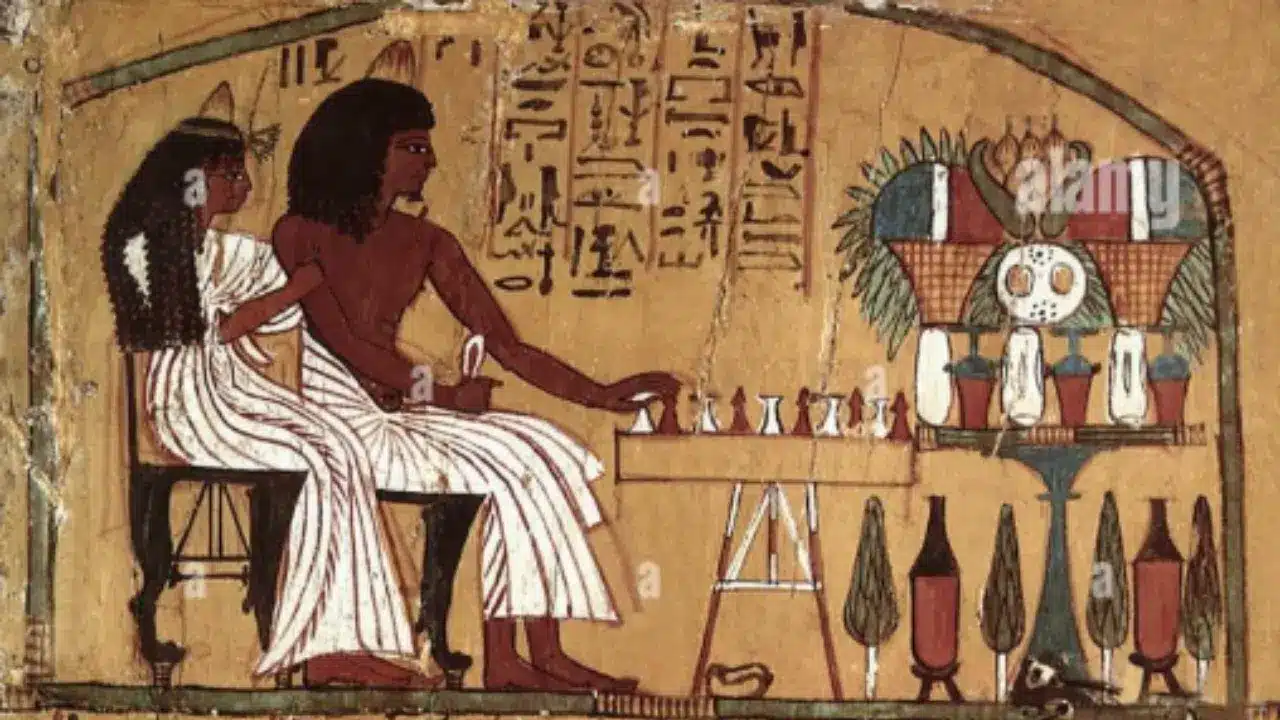
How a Simple Game Became a Symbol of Spiritual Journey and Destiny
Senet is one of the most fascinating windows into Ancient Egyptian daily life — and into Ancient Egyptian beliefs about death, rebirth, and the afterlife. Long before modern board games, Egyptians played Senet as entertainment, but also as something far more serious: a symbolic journey through the dangers and tests of the underworld.
At EgyptDiscovering, we love the moments where history stops being “museum quiet” and becomes human again. Senet does exactly that. It shows Egyptians laughing, competing, thinking strategically — and at the same time preparing their souls for eternity.
What Is Senet?
Senet is widely considered the oldest known board game from Ancient Egypt. Its name is often translated as “passing”, a word that fits perfectly with the way Egyptians later understood the game: passing from one state to another, from life to death, and from death to the afterlife.
Senet boards have been found in tombs and elite burials, indicating the game’s importance across centuries. It was not simply a pastime. It became part of the symbolic world that surrounded death and the hope of safe passage to the Field of Reeds — the ideal afterlife in Ancient Egyptian religion.
Why Senet Was Placed in Tombs
The presence of Senet in tombs was not accidental. Egyptians buried objects that could support the deceased in the next world: food, jewellery, amulets, texts, and sometimes games. Senet appears to have served as both comfort and protection — a familiar ritual object, and a spiritual metaphor for overcoming obstacles on the road to eternity.
How Senet Was Played
The Senet board is a grid of 30 squares, usually arranged in three rows of ten. Players moved their pieces according to the throw of casting sticks or knucklebones, functioning like an early form of dice.
Even though not every rule has survived with certainty, the structure of the board and surviving depictions strongly suggest a mixture of strategy and chance. This balance mattered: in Ancient Egyptian thought, fate and divine order were always present, but human action still counted.
The Board as a Map of the Afterlife
Over time, Senet became increasingly symbolic. Certain squares appear to have represented key dangers and turning points in the soul’s journey. Many modern reconstructions refer to the “House of Water” as a perilous square and the final squares as zones of safety and fulfilment, sometimes described as a “House of Happiness”.
Whether played in life or placed in a tomb for the dead, Senet became a miniature drama of passage: risk, judgement, protection, and arrival.
Senet and Ancient Egyptian Religion
Senet’s deeper power lies in how it blends play with belief. Egyptians did not sharply separate the everyday world from the sacred world. Ritual and daily life overlapped. A game could be entertainment and spiritual practice at the same time.
Winning in Senet was more than a social victory. In later periods, it could be read as a sign of divine favour — an omen that the gods supported one’s passage, one’s balance with Ma’at, and one’s readiness for what came after death.
Senet and Tutankhamun
Senet boards were discovered among the treasures of Tutankhamun, reinforcing the idea that the game was not only popular but meaningful. For a pharaoh — a divine ruler expected to unite earthly and cosmic order — a game representing spiritual passage was an ideal companion for eternity.
Why Senet Still Captivates Travellers Today
Senet remains compelling because it makes Ancient Egypt feel close. It reveals a civilisation that was monumental, yes — but also intimate. People played games, argued over rules, celebrated luck, feared loss, and looked for meaning in patterns.
For travellers exploring Egypt, these details matter. Temples and tombs show the grandeur of the civilisation. But objects like Senet show the human mind behind it: curiosity, strategy, humour, and the timeless desire to win against fate.
At EgyptDiscovering, we share stories like Senet because they help visitors experience Egypt as a living culture, not just as a list of monuments. The past becomes real when it feels personal.
A Board Game That Became a Journey
Senet began as a game. It became a spiritual metaphor. And today, it remains one of the clearest reminders that Ancient Egypt was not only built in stone — it was lived in moments.
One move at a time, Senet carried Egyptians through their greatest question of all: what happens after life ends?