
A Civilisation Built on a River
If Egypt exists where it does, as we explored earlier, it is because of the Nile. But the river did far more than make life possible. It created the conditions for the longest-lasting civilisation in human history.
For more than three millennia, from the early dynastic period around 3100 BCE until the Roman annexation of Egypt in 30 BCE, Egyptian civilisation maintained a remarkable cultural and political continuity. Dynasties rose and fell, capitals shifted, and foreign rulers occasionally appeared, yet the fundamental structure of Egyptian society—its religion, language, administration, and relationship with the Nile—remained recognisably the same.
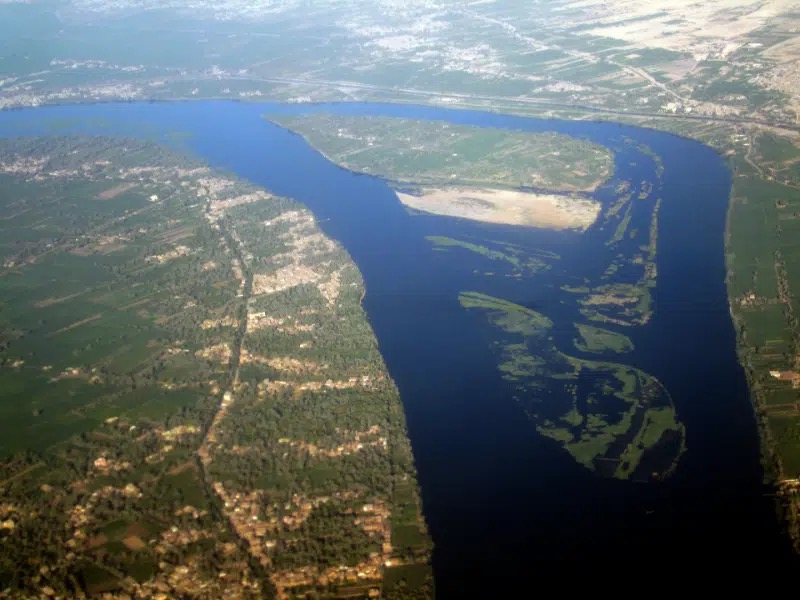
Few civilisations in history display such extraordinary longevity within the same geographical and cultural framework. The explanation lies not only in political organisation or religious tradition, but above all in geography. Egypt was shaped by a landscape unlike any other: a narrow fertile corridor carved by the Nile through vast surrounding deserts.
Without the Nile, Egypt would have been an extension of the Sahara.
With it, the land became one of the most productive agricultural regions of the ancient world. Each year the river flooded its banks, depositing fertile black silt that renewed the soil and made stable agriculture possible.
It is no coincidence that the ancient Egyptians called their land Kemet, meaning “the Black Land,” referring to the dark fertile soil created by the flood. Beyond this narrow ribbon lay Deshret, “the Red Land,” the immense deserts that surrounded and protected the valley.
In this sense, Egypt was not simply a country beside a river. It was a civilisation created by one.
The Three Seasons of the Nile
The rhythm of Egyptian life followed the annual cycle of the river. The ancient Egyptian calendar was divided into three agricultural seasons, each determined by the behaviour of the Nile.
Akhet — The Flood Season
The first season, Akhet, lasted roughly from June to September. During this time the Nile overflowed its banks as rainfall from the Ethiopian highlands fed the Blue Nile.
The floodwaters spread across the valley, covering fields and depositing the fertile silt that made Egyptian agriculture possible. Although farming paused during this period, the flood was welcomed as a divine gift.
The abundance of the river was personified by the god Hapi, who symbolised fertility and prosperity.
Peret — The Growing Season
Once the waters receded, the second season began: Peret, the season of emergence and growth.
Farmers ploughed the softened soil and planted crops such as wheat, barley, and flax. Irrigation channels carried water to the fields, allowing plants to grow throughout the valley.
This was the moment when the miracle of the Nile revealed its full power. From a narrow ribbon of land, Egypt could produce food in abundance.
Shemu — The Harvest Season
The final season, Shemu, was the harvest season, extending roughly from March to May.
Grain was gathered and stored in granaries, forming the agricultural surplus that supported the Egyptian state. That surplus fed cities, priests, craftsmen, and the labour force that built the pyramids and temples.
Remarkably, the same agricultural rhythm shaped Egyptian life for thousands of years and is still recognisable in the country today.
The Nile as Egypt’s First Highway

The Nile was not only the source of life and agriculture. It was also Egypt’s first great transportation system.
The river flows naturally from south to north, descending from the highlands of East Africa toward the Mediterranean Sea — a geographical phenomenon explored in more detail in our article Why Does the Nile Flow North.
At the same time, the prevailing winds of the Nile valley blow from north to south.
This rare geographical balance created a natural navigation system. Boats travelling north could simply follow the current of the river, while boats travelling south could raise their sails and use the steady northern winds.
This allowed movement in both directions along the river long before the construction of roads or modern infrastructure. Merchants, officials, pilgrims, and travellers moved along this watery corridor carrying goods, ideas, and traditions from one end of the country to the other.
Even today, traditional sailing boats such as feluccas and dahabiyas still rely on this same natural relationship between current and wind.
The Nile and the Birth of the Egyptian State
Because nearly every settlement developed along the same river corridor, the Nile also shaped Egypt’s political organisation.
Over time two major regions emerged:
• Upper Egypt, the southern Nile valley
• Lower Egypt, the northern Nile delta
Around 3100 BCE, these regions were unified under a single ruler, traditionally identified as Narmer, marking the birth of the Egyptian state.
The river itself made this unity possible. Communication, administration, and trade all followed the same geographical axis. Few ancient civilisations possessed such a clear natural structure for political cohesion.
The Nile as a Sacred Landscape
For the ancient Egyptians the Nile was far more than a physical river. It was a sacred presence woven into religion, myth, and cosmology.
The annual flood symbolised rebirth and renewal. The myth of Osiris, god of the afterlife, reflected this idea: life emerging again after death, just as the flood renewed the land each year.
Temples were often aligned with the river, and sacred processions moved along its waters during religious festivals. The Nile therefore shaped not only agriculture and politics but also the spiritual imagination of Egypt.
The River That Still Defines Egypt
Thousands of years later, the Nile continues to define Egypt’s geography and life.
Modern cities, agriculture, and transportation still follow the same narrow valley that sustained ancient civilisation. From space, Egypt still appears as a striking contrast: a thin green ribbon running through a vast desert.
Travelling along the Nile today reveals a landscape that has changed remarkably little over millennia, something beautifully described in Nile Narratives: A Timeless Journey Through the Heart of Egypt.
Temples, villages, palm groves, and desert cliffs still follow the same ancient rhythm of the river.
Perhaps the real question is not how Egypt used the Nile, but how the Nile shaped Egypt itself.
The deeper question, as Dr Watson might observe, is this: did a civilisation grow beside the Nile, or did the Nile itself create it?