

Discover the Largest Temple Complex in Egypt
In the heart of Luxor, on the eastern bank of the Nile, stands one of the most extraordinary monuments ever created by humanity — Karnak Temple. More than a historical site, Karnak is a vast sacred city built over nearly two thousand years, dedicated primarily to the god Amun-Ra, the supreme deity of ancient Thebes.
For travellers exploring Egypt, visiting Karnak is not simply sightseeing. It is an immersion into the spiritual, architectural, and political power of Ancient Egyptian civilisation. Every column, statue, and carved wall reflects a culture that sought permanence, cosmic harmony, and connection with the divine.
Karnak is not just a monument of the past. It is an experience that transforms the way visitors understand Egypt.
Entering Karnak: Walking Through the Gateway of the Gods
Approaching Karnak Temple is unforgettable. The grand avenue of ram-headed sphinxes leads visitors towards monumental pylons that once marked the entrance to sacred space. Crossing this threshold feels like stepping into another world — one where gods and pharaohs shaped reality together.
The scale of Karnak is astonishing. Covering more than 100 hectares, it remains the largest religious complex ever built in the ancient world. Generations of pharaohs expanded the temple, each leaving architectural signatures that still stand today.
This continuity makes Karnak unique: it is not the creation of one ruler but the achievement of an entire civilisation across centuries.
The Hypostyle Hall: Architecture Beyond Imagination
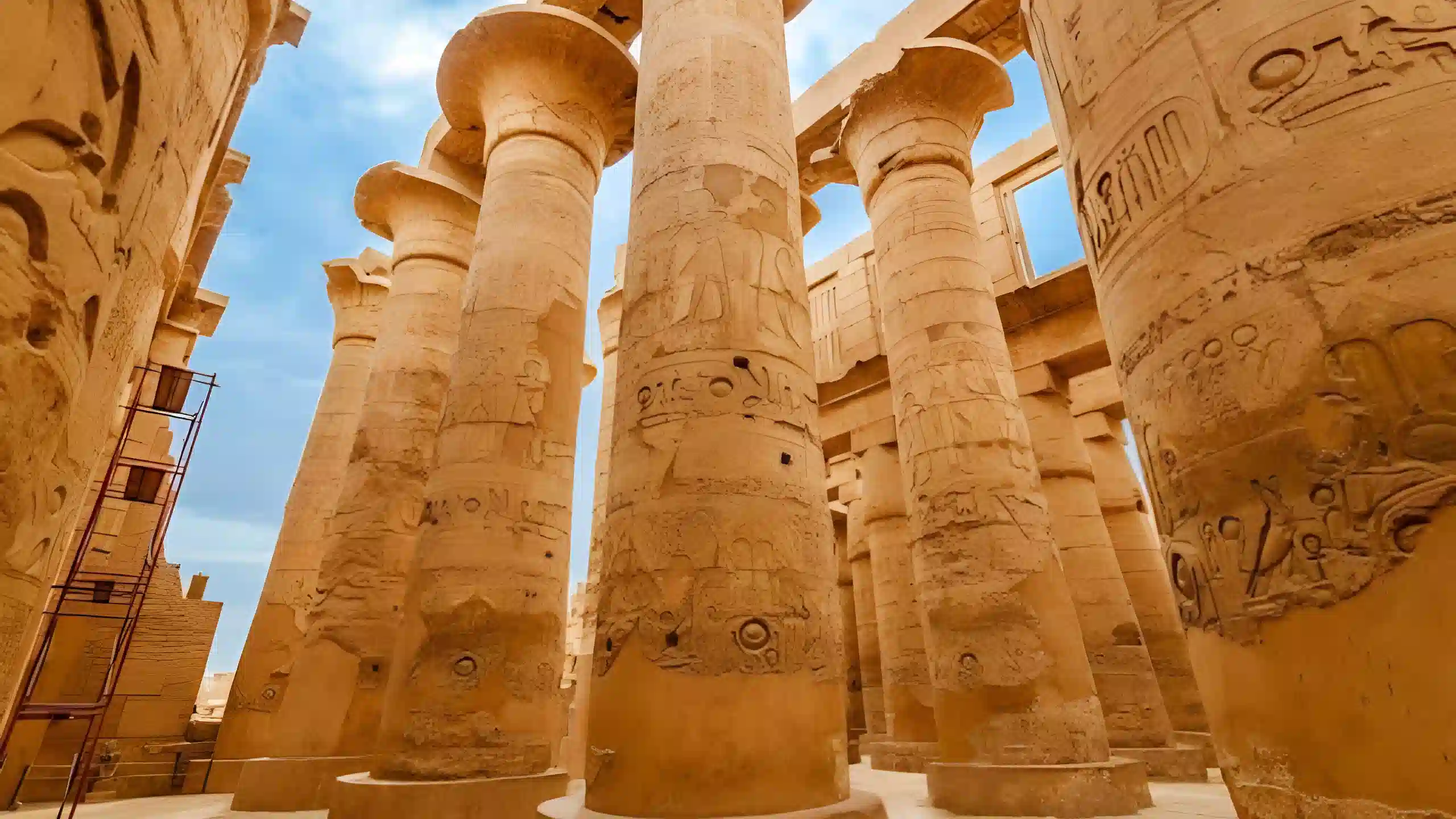
The most famous section of Karnak is the Great Hypostyle Hall, a breathtaking forest of 134 colossal stone columns, some reaching over 20 metres high. Walking between them creates a powerful sense of human scale against monumental ambition.
Hieroglyphic inscriptions cover the columns, recording religious rituals, royal victories, and offerings to the gods. Sunlight filtering through the stone structures creates shifting shadows that change throughout the day, enhancing the sense of timelessness.
For many visitors, this is one of the most awe-inspiring spaces in all of Egypt.
Sacred Spaces and Spiritual Meaning
Karnak was not only an architectural masterpiece; it was a living religious centre. Priests performed daily rituals, festivals honoured the gods, and ceremonies connected the divine world with human society.
One of the most peaceful areas within the complex is the Sacred Lake, used for ritual purification. Its still waters reflect surrounding monuments, creating a moment of calm within the vast temple environment.
Ancient Egyptians believed temples were places where cosmic order — Ma’at — was maintained. Standing inside Karnak today, travellers often sense this profound spiritual dimension that transcends time.
Karnak and the Nile: The Heart of Egyptian Power
The temple’s location near the Nile was not accidental. The river served as the main transport route, allowing statues, obelisks, and building materials to reach the site. Religious processions also travelled between Karnak and Luxor Temple along ceremonial avenues.
This connection between temple and river reveals how geography shaped Egyptian civilisation. The Nile was not only a source of life but also a pathway of belief, politics, and cultural unity.
Travellers exploring Luxor as part of a Nile journey experience this same historical landscape that once connected temples, cities, and kingdoms.
Visiting Karnak Today: A Highlight of Any Egypt Journey
Today, Karnak remains one of the most important destinations for anyone travelling to Egypt. Whether visiting Luxor independently or as part of a Nile cruise from Aswan to Luxor, the temple offers a direct encounter with one of the world’s greatest civilisations.
Exploring Karnak with knowledgeable local guides deepens the experience, revealing stories hidden within hieroglyphs, symbolism, and architecture.
At Egypt Discovering, journeys through Upper Egypt are designed to connect travellers not only with monuments but with the living culture surrounding them — from the Nile landscapes to local communities and traditions.
A Timeless Monument of Human Ambition
Karnak stands as a reminder that human creativity can reach beyond centuries. Built stone by stone across generations, it embodies the ancient Egyptian pursuit of eternity — the desire to create something lasting, meaningful, and aligned with the cosmos.
For modern visitors, Karnak is more than a historical site. It is a place where past and present meet, where imagination expands, and where the scale of human achievement becomes tangible.
Standing among its towering columns, one understands why Egypt continues to inspire travellers from around the world.
Karnak is not simply a destination.
It is a journey through time itself.