



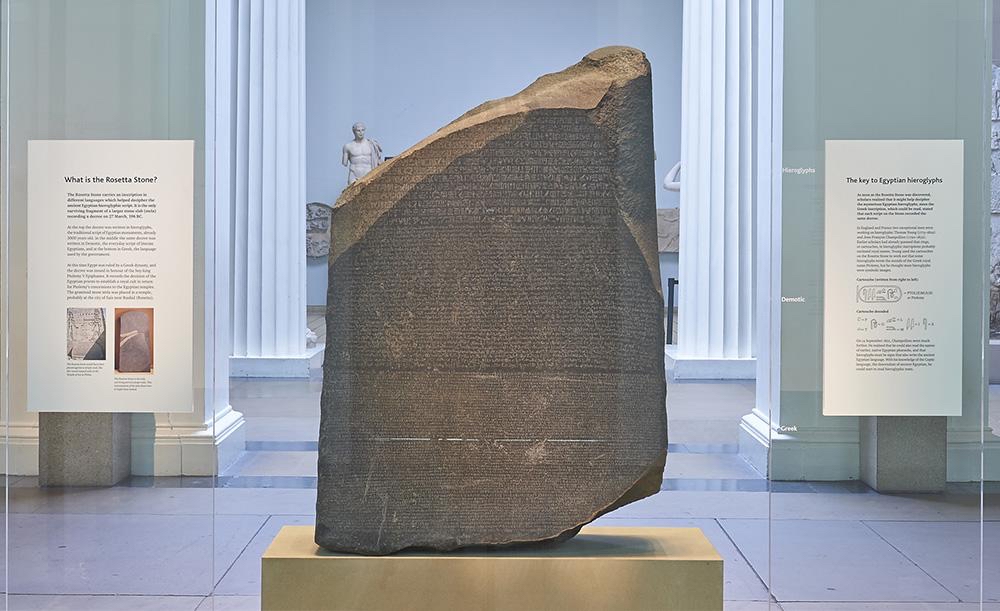
Few discoveries have transformed our understanding of the ancient world as profoundly as the Rosetta Stone.
Today it stands in London, visited by millions every year. Yet its story began more than two thousand years ago in Egypt and ultimately transformed our understanding of more than four thousand years of Egyptian civilisation.
Without it, much of Ancient Egypt might still remain silent.
A Stone Found by Chance
The story begins in 1799.
Napoleon Bonaparte had invaded Egypt the previous year. His expedition was not composed solely of soldiers. It also included engineers, scientists, cartographers, linguists and scholars. France had come to Egypt with an army, but also with curiosity.
Near the city of Rashid, known in Europe as Rosetta, French troops were strengthening Fort Julien when a dark granodiorite stone covered with inscriptions emerged from the ground.
Many ancient stones had been reused in Egyptian buildings for centuries. This one could easily have disappeared into another wall.
Instead, a French military engineer, Pierre-François Bouchard, recognised that the discovery might be extraordinary.
History would later celebrate emperors, museums and scholars. Few people remember Bouchard. Yet had he not ordered the stone preserved, the history of Egyptology might have taken a very different path.
Egypt Under the Ptolemies
The Rosetta Stone was carved in 196 BC during the reign of Ptolemy V.
This was not the Egypt of the pyramid builders, nor the Egypt of Tutankhamun or Ramesses II.
The country was ruled by the Ptolemaic dynasty, descendants of one of Alexander the Great’s generals.
The inscription appears in three scripts:
- Hieroglyphic, the sacred script of temples and monuments.
- Demotic, the administrative script used by Egyptians in daily life.
- Greek, the language of government and the ruling elite.
The decree honoured a young king.
What nobody realised at the time was that it would one day become the key to unlocking an entire civilisation.
A Civilisation That Had Fallen Silent

By the time the Rosetta Stone was carved, hieroglyphs already belonged to an ancient tradition.
Government administration functioned in Demotic and Greek. Hieroglyphs survived mainly within temples and religious monuments.
As centuries passed, the knowledge required to read them disappeared.
The temples closed.
The priesthood vanished.
The language was forgotten.
Across Egypt, magnificent inscriptions remained visible on temple walls, tombs and monuments, yet nobody could understand them.
One of humanity’s greatest civilisations had left behind an immense written archive that could no longer be read.
To understand the scale of what was recovered through the decipherment of hieroglyphs, it is worth exploring how the Nile shaped the rise of Egyptian civilisation in the first place.
The Key to Ancient Egypt
The Rosetta Stone did not reveal a hidden treasure.
It revealed a lost language.
Because the same decree appeared in Greek, scholars realised that the unknown Egyptian texts might eventually be deciphered.
For years, Europe attempted to solve the puzzle.
The breakthrough came in 1822 through the work of Jean-François Champollion.
He demonstrated that hieroglyphs were not merely symbolic images or mystical signs. They were a sophisticated writing system capable of recording names, sounds, ideas, history and human thought.
Following his breakthrough, Champollion spent more than a year travelling through Egypt and Nubia, studying inscriptions in temples, tombs and monuments throughout the Nile Valley.
The journey confirmed something extraordinary.
The Rosetta Stone was not merely helping scholars decipher an ancient script.
It was opening the door to the meaning, history, religion, administration and daily life of one of the world’s oldest civilisations.
Ancient Egypt could speak again.
And for the first time, historians could begin to understand Egypt through Egyptian voices rather than through the writings of foreign observers.
Egyptology was born.
The Rosetta Stone Was Not Alone
Although the Rosetta Stone became world famous, it was not the only trilingual inscription from Ptolemaic Egypt.
Another important example is the Canopus Decree of 238 BC, today preserved in the Egyptian Museum in Cairo.
Like the Rosetta Stone, it contains the same text written in hieroglyphic, Demotic and Greek.
Together with other multilingual inscriptions discovered later, it helped scholars verify and refine the decipherment of ancient Egyptian writing.
Had history unfolded differently, the Canopus Decree might have become the world’s most famous stone.
Instead, fate chose Rosetta.
How the Stone Reached London
The Rosetta Stone was discovered by the French.
It never reached France.
In 1801, French forces in Egypt were defeated by British and Ottoman armies.
Under the Capitulation of Alexandria, the antiquities collected by the French became part of the settlement between the victorious powers.
The stone was transferred to Britain and arrived in London in 1802.
One historical fact remains difficult to ignore.
No Egyptian authority participated in the agreement through which the Rosetta Stone left Egypt.
Since then, the Rosetta Stone has remained one of the most visited objects in the British Museum.
More Than Fifty Years of Requests
The question of the Rosetta Stone’s future has remained alive for generations.
Successive Egyptian governments have raised the issue for more than half a century.
Requests have been made from the era of President Gamal Abdel Nasser through later administrations and continue today under President Abdel Fattah el-Sisi.
Behind these efforts stand generations of diplomats, archaeologists, historians, museum specialists and cultural heritage experts whose work has kept the discussion alive for decades.
Diplomacy often moves slowly.
History moves even more slowly.
The story of the Rosetta Stone remains unfinished.
Another question is increasingly being asked.
If the Rosetta Stone remains in London, should Egypt receive some form of recognition or benefit from an object discovered on Egyptian soil, created by Egyptian civilisation and central to Egyptian history?
Cultural heritage is not only about ownership.
It is also about recognition, responsibility and fairness.
Egypt and the Great Museums of Europe
The Rosetta Stone is not alone.
Across Europe, some of the greatest treasures of ancient civilizations stand far from the lands where they were created.
London
Visitors encounter the Rosetta Stone, Egyptian mummies and Assyrian masterpieces.
Berlin
The famous Bust of Nefertiti remains one of the most celebrated works of ancient Egyptian art, while the monumental Ishtar Gate of Babylon is among the most impressive archaeological reconstructions in the world.
Paris
Paris houses one of the largest collections of Egyptian antiquities outside Egypt.
The story of the Rosetta Stone therefore belongs to a wider story.
The story of how the great civilisations of Egypt, Mesopotamia and the ancient Near East became part of the collections of Europe’s great museums.
The Luxor Obelisk and the Clock That Never Worked
One of the most curious chapters of that story stands in the centre of Paris.
The Luxor Obelisk, carved more than three thousand years ago during the reign of Ramesses II, originally stood at the entrance of Luxor Temple.
In the early nineteenth century, Muhammad Ali Pasha, founder of modern Egypt, offered the two Luxor obelisks to France.
The transfer was carried out during the reign of King Louis-Philippe I of France.
Transporting a 23-metre granite monument across the Mediterranean was an extraordinary achievement of engineering and logistics.
Today the obelisk dominates the Place de la Concorde.
In return, France presented Egypt with a magnificent mechanical clock intended for the Citadel of Cairo and the Mosque of Muhammad Ali.
The exchange entered history for an unexpected reason.
The obelisk still stands proudly in Paris.
The clock reportedly never worked properly. Visitors to Cairo can still see the famous clock today.
History occasionally has a sense of humour.
Not every historical transfer followed the same path. While one Luxor obelisk remains in Paris, the second still stands in Luxor, where visitors can admire it today beside the temple for which it was originally carved.
More Than a Stone
The Rosetta Stone is often described as one of the most important archaeological discoveries ever made.
That description is justified.
Its greatest achievement was not simply translating a text.
It reopened the archives of more than four thousand years of Egyptian civilisation. Yet Egypt is more than its monuments and inscriptions. It remains a living civilization that continues to evolve today.
Today travellers exploring Egypt can understand temples, tombs and monuments because Pierre-François Bouchard recognised in 1799 that a seemingly ordinary stone deserved to be preserved. His decision changed history.
The debate over where the Rosetta Stone should stand will likely continue.
Its greatest legacy extends far beyond the museum where it is displayed today.
Its legacy is that Ancient Egypt can speak to us again, revealing to travellers, visitors and scholars the greatness of a civilisation that shaped human history for more than four millennia and still has much to tell us.